
Browse the Society
✦ The complete extended archive · October 2026
Human Survival
Field Guide.
All 50 pages, original illustrations, paired modes, practices, capacities, and research notes. Choose the original page or readable text.
Search this book
PAGE 48 / 50 · Research Ledger / 02
Read the full text of this page
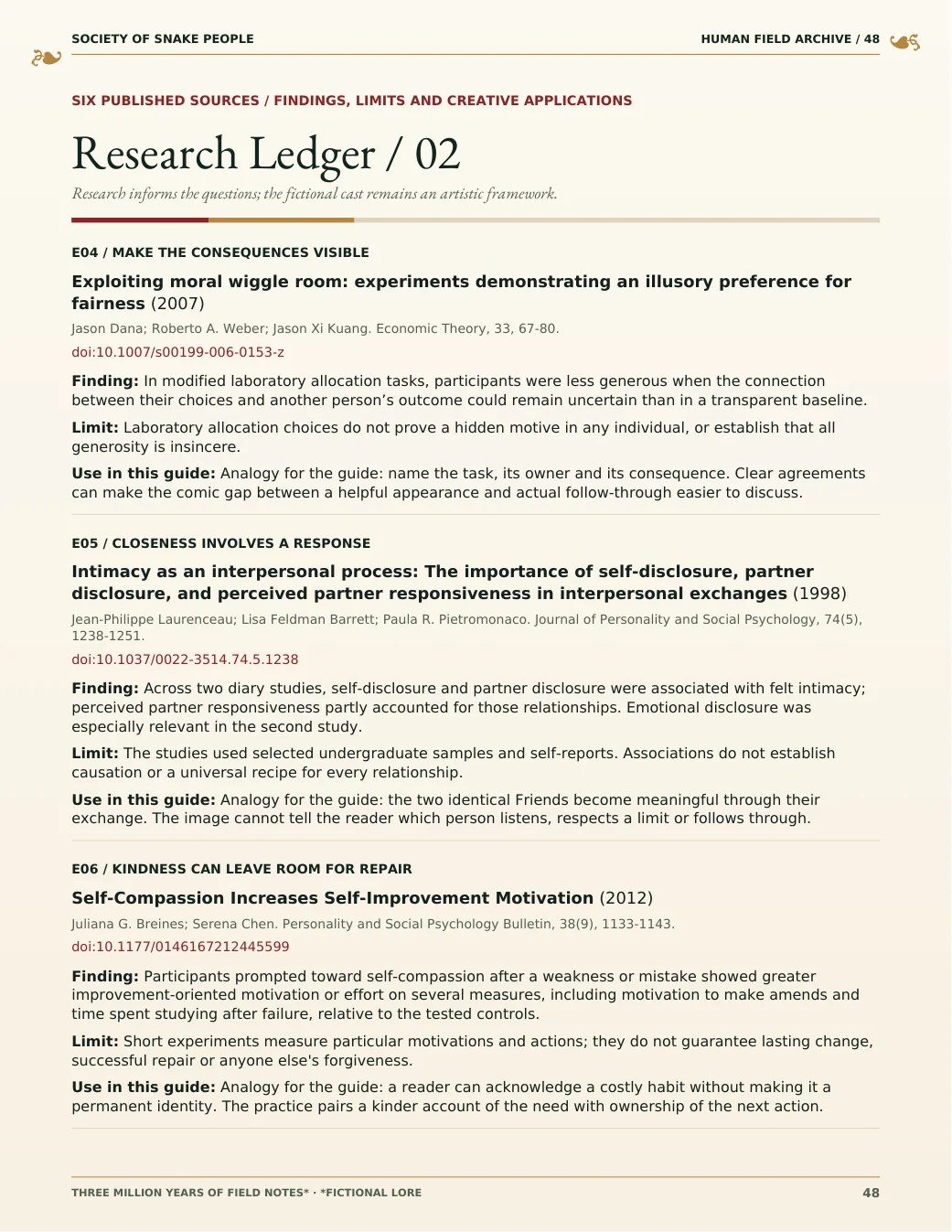
SIX PUBLISHED SOURCES / FINDINGS, LIMITS AND CREATIVE APPLICATIONS Research Ledger / 02
Research informs the questions; the fictional cast remains an artistic framework.
E04 / MAKE THE CONSEQUENCES VISIBLE
Exploiting moral wiggle room: experiments demonstrating an illusory preference for fairness (2007)
Jason Dana; Roberto A. Weber; Jason Xi Kuang. Economic Theory, 33, 67-80.
doi:10.1007/s00199-006-0153-z
Finding: In modified laboratory allocation tasks, participants were less generous when the connection between their choices and another person’s outcome could remain uncertain than in a transparent baseline.
Limit: Laboratory allocation choices do not prove a hidden motive in any individual, or establish that all generosity is insincere.
Use in this guide: Analogy for the guide: name the task, its owner and its consequence. Clear agreements can make the comic gap between a helpful appearance and actual follow-through easier to discuss.
E05 / CLOSENESS INVOLVES A RESPONSE
Intimacy as an interpersonal process: The importance of self-disclosure, partner disclosure, and perceived partner responsiveness in interpersonal exchanges (1998)
Jean-Philippe Laurenceau; Lisa Feldman Barrett; Paula R. Pietromonaco. Journal of Personality and Social Psychology, 74(5), 1238-1251.
doi:10.1037/0022-3514.74.5.1238
Finding: Across two diary studies, self-disclosure and partner disclosure were associated with felt intimacy; perceived partner responsiveness partly accounted for those relationships. Emotional disclosure was especially relevant in the second study.
Limit: The studies used selected undergraduate samples and self-reports. Associations do not establish causation or a universal recipe for every relationship.
Use in this guide: Analogy for the guide: the two identical Friends become meaningful through their exchange. The image cannot tell the reader which person listens, respects a limit or follows through.
E06 / KINDNESS CAN LEAVE ROOM FOR REPAIR
Self-Compassion Increases Self-Improvement Motivation (2012)
Juliana G. Breines; Serena Chen. Personality and Social Psychology Bulletin, 38(9), 1133-1143.
doi:10.1177/0146167212445599
Finding: Participants prompted toward self-compassion after a weakness or mistake showed greater improvement-oriented motivation or effort on several measures, including motivation to make amends and time spent studying after failure, relative to the tested controls.
Limit: Short experiments measure particular motivations and actions; they do not guarantee lasting change, successful repair or anyone else's forgiveness.
Use in this guide: Analogy for the guide: a reader can acknowledge a costly habit without making it a permanent identity. The practice pairs a kinder account of the need with ownership of the next action.
About this reading edition
The illustrated view preserves the original page layout. Readable text is transcribed from the source PDF and follows its text blocks; some column and table formatting is simplified. The new poster’s Playbook wording appears on the dedicated Playbook page. The older wording here remains part of the source record.
Download the consolidated edition