
For the curious. The questioning. The splendidly unfinished. WELCOME, SNAKE PERSON.
Browse the Society
Illustrated Field Guide

✦   A conversational evasion map

The Human
Manipulator
Playbook.

Recognize the pattern.
Keep the question. Keep your agency.

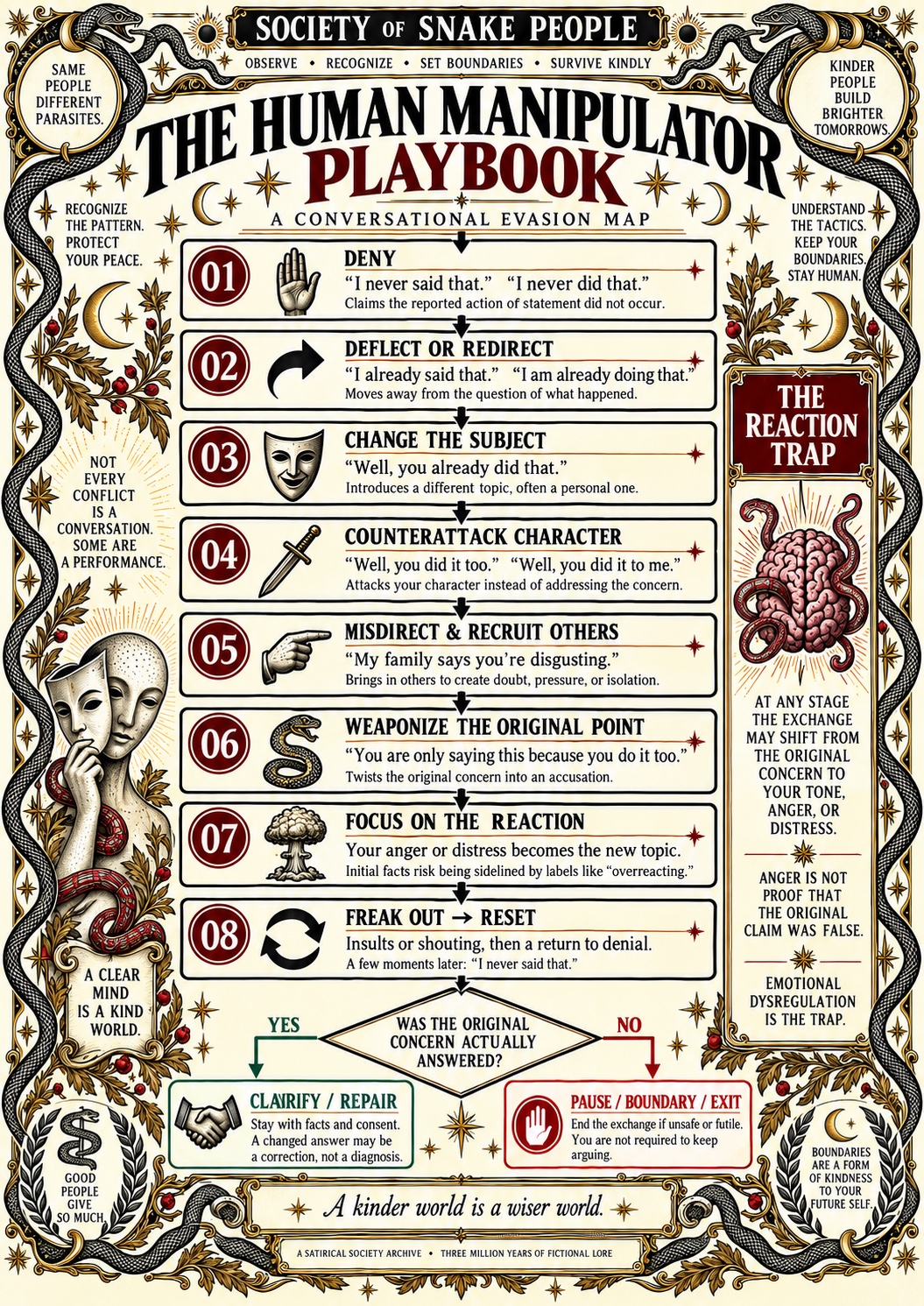
The concern can disappear while the conversation continues. This map names eight possible detours and returns to one question: was the original concern answered?

Moves may appear alone, repeat, overlap, or never occur. Their order does not establish intention. The response is something you can choose; it cannot make another person cooperate.

Explore the eight moves
The Human Manipulator PlaybookOriginal
The Human Manipulator Playbook — full original plate
01

✦   Deny

Deny

“I never said that. I never did that.”

The reported event or statement is disputed.

The pull

The conversation can become a contest over memory before the specific disagreement is identified.

A useful distinction

A denial may be accurate. If the evidence changes your account, correct it.

Words to try

“Which specific fact do we disagree about? Let’s check the message or agreement.”

Return to the concern

Agree on what is known, disputed, and still uncertain.
02

✦   Deflect or redirect

Deflect or redirect

“I already said that. I am already doing that.”

A related effort or assertion replaces a direct answer to what happened.

The pull

You may feel pressured to prove you appreciate everything else before the original question can be answered.

A useful distinction

A relevant explanation can answer the concern. An adjacent success may not.

Words to try

“I hear that. My question is whether this specific commitment was completed.”

Return to the concern

Bring the exchange back to the particular action or agreement.

03

✦   Change the subject

Change the subject

“Well, you already did that.”

A different topic takes the place of the original concern.

The pull

Following every new thread makes the first question disappear.

A useful distinction

A second concern can be legitimate and still need its own conversation.

Words to try

“We can discuss that separately. First, can we finish the question about Tuesday?”

Return to the concern

Give the new concern a place without abandoning the first.

04

✦   Counterattack character

Counterattack character

“Well, you did it too. Well, you did it to me.”

The questioner’s character becomes the subject instead of the action under discussion.

The pull

Defending your entire character uses the time that could have clarified the event.

A useful distinction

Relevant conduct matters. An insult or general verdict does not answer a factual question.

Words to try

“I will discuss a specific concern about my conduct separately. What is the answer to this question?”

Return to the concern

Separate the two concerns, and pause if insults continue.

05

✦   Misdirect & recruit others

Misdirect & recruit others

“My family says you’re disgusting.”

Other people’s alleged opinions are introduced to create pressure, doubt, or isolation.

The pull

You may start defending yourself to an imagined audience instead of addressing the people and facts involved.

A useful distinction

An independent witness or support person can be useful. An unnamed chorus is not a substitute for relevant evidence.

Words to try

“What specific event are we discussing, and how does that information answer the question?”

Return to the concern

Ask for the relevant observation, not a vote on your worth.

06

✦   Weaponize the original point

Weaponize the original point

“You are only saying this because you do it too.”

The concern is turned back into an accusation or used as leverage: ‘If you care about fairness, do my share.’

The pull

You are pushed to prove the value you raised by giving up the boundary it was meant to protect.

A useful distinction

Apply the same standard to yourself. A valid counterconcern still does not establish consent to a new demand.

Words to try

“We can examine my conduct separately. Caring about this does not mean I agreed to that request.”

Return to the concern

Clarify the original issue, the new allegation, and what was actually agreed.

07

✦   Focus on the reaction

Focus on the reaction

“Your anger or distress becomes the new topic.”

Attention shifts from the original concern to your tone, anger, or distress.

The pull

Trying to prove that you are calm can replace deciding what to do about the unresolved concern.

A useful distinction

Emotions do not prove or disprove a claim. Harmful behavior during a reaction also deserves its own accountability.

Words to try

“I’m upset, and I’m taking a pause. The question about the agreement remains unanswered.”

Return to the concern

Address the reaction and the original facts as separate matters.

08

✦   Freak out → reset

Freak out → reset

“Insults or shouting, then a return to denial.”

Escalation interrupts the exchange, then discussion restarts without resolving what came before.

The pull

The restart can invite another round of the same argument, with less energy and less clarity.

A useful distinction

Distress can be sincere. You can acknowledge it and still stop participating in an unsafe or futile exchange.

Words to try

“I am stopping here. This is the unresolved question. We can revisit it only in a workable conversation.”

Return to the concern

Preserve the question and choose a pause, boundary, alternative arrangement, or exit.

✦   Break the loop

Was the original concern
actually answered?

Select the situation that fits. You can leave the loop at any stage.

Edition note. This page follows the newly supplied poster. Its sixth step also retains the earlier guide’s idea of using the original concern as leverage. The older eight-label wording remains visible in the archive as a dated source.