
Browse the Society
✦ The complete extended archive · October 2026
Human Survival
Field Guide.
All 50 pages, original illustrations, paired modes, practices, capacities, and research notes. Choose the original page or readable text.
Search this book
PAGE 47 / 50 · Research Ledger / 01
Read the full text of this page
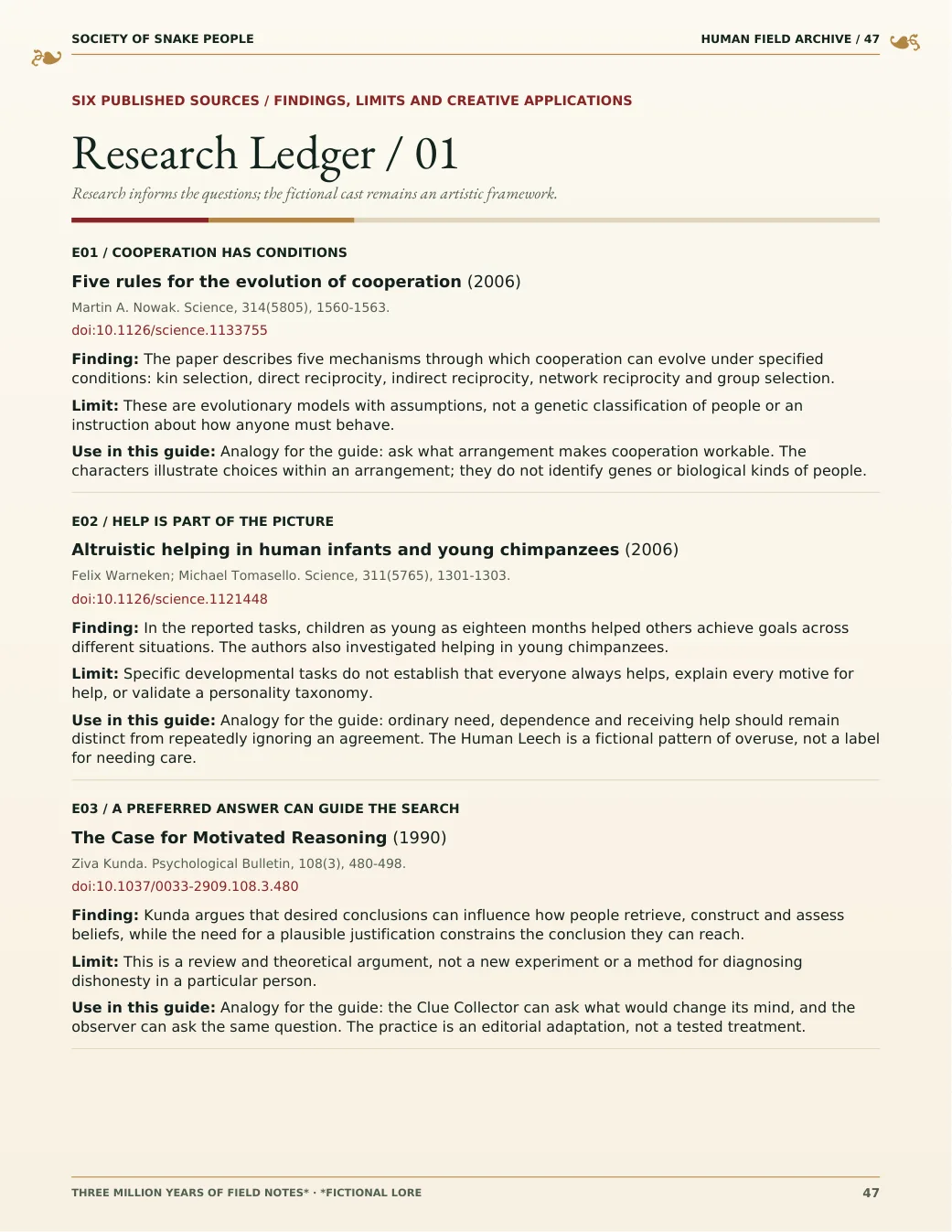
SIX PUBLISHED SOURCES / FINDINGS, LIMITS AND CREATIVE APPLICATIONS Research Ledger / 01
Research informs the questions; the fictional cast remains an artistic framework.
E01 / COOPERATION HAS CONDITIONS
Five rules for the evolution of cooperation (2006)
Martin A. Nowak. Science, 314(5805), 1560-1563.
doi:10.1126/science.1133755
Finding: The paper describes five mechanisms through which cooperation can evolve under specified conditions: kin selection, direct reciprocity, indirect reciprocity, network reciprocity and group selection.
Limit: These are evolutionary models with assumptions, not a genetic classification of people or an instruction about how anyone must behave.
Use in this guide: Analogy for the guide: ask what arrangement makes cooperation workable. The characters illustrate choices within an arrangement; they do not identify genes or biological kinds of people.
E02 / HELP IS PART OF THE PICTURE
Altruistic helping in human infants and young chimpanzees (2006)
Felix Warneken; Michael Tomasello. Science, 311(5765), 1301-1303.
doi:10.1126/science.1121448
Finding: In the reported tasks, children as young as eighteen months helped others achieve goals across different situations. The authors also investigated helping in young chimpanzees.
Limit: Specific developmental tasks do not establish that everyone always helps, explain every motive for help, or validate a personality taxonomy.
Use in this guide: Analogy for the guide: ordinary need, dependence and receiving help should remain distinct from repeatedly ignoring an agreement. The Human Leech is a fictional pattern of overuse, not a label for needing care.
E03 / A PREFERRED ANSWER CAN GUIDE THE SEARCH
The Case for Motivated Reasoning (1990)
Ziva Kunda. Psychological Bulletin, 108(3), 480-498.
doi:10.1037/0033-2909.108.3.480
Finding: Kunda argues that desired conclusions can influence how people retrieve, construct and assess beliefs, while the need for a plausible justification constrains the conclusion they can reach.
Limit: This is a review and theoretical argument, not a new experiment or a method for diagnosing dishonesty in a particular person.
Use in this guide: Analogy for the guide: the Clue Collector can ask what would change its mind, and the observer can ask the same question. The practice is an editorial adaptation, not a tested treatment.
About this reading edition
The illustrated view preserves the original page layout. Readable text is transcribed from the source PDF and follows its text blocks; some column and table formatting is simplified. The new poster’s Playbook wording appears on the dedicated Playbook page. The older wording here remains part of the source record.
Download the consolidated edition